Nature Walkway Masured Design Plans Wood Drawing
What Is a Construction Plan? Definition, Uses, and History
Construction plans differ from maps, which embrace much larger areas and have much larger calibration ratios. Rather, a typical construction plan depicts simply i construction and its parts or sections. By irresolute perspectives and details, it tin do and so in a number of means.
Construction drawings as well fill an important function in the overall structure planning process. Edifice departments and local governments must review plans earlier they will issue structure or renovation permits. Planners judge building material and labor costs based on plans. In the pre-structure planning and scheduling phase, contractors utilise plans to create work breakdowns and schedule structure tasks. Once construction gets underway, drawings guide the piece of work.
As physicist John Swain writes for the Boston Earth, blueprints originated after an 1861 discovery by French pharmacist Alphonse Louis Poitevin. He found that the chemical ferro-gallate, derived from glue, could permanently plough a vivid shade of bluish when exposed to strong light. To create a pattern, one would first place the translucent paper of an architectural drawing over paper coated with unexposed ferro-gallate. Then, they would betrayal the newspaper layering to strong natural light. As light passed through the translucent top sheet, turning the ferro-gallate canvas beneath information technology bluish (except for where the drawn lines on the top sheet prevented light from passing through to the lesser sheet), the chemical combination would reproduce a circuitous, finely detailed drawing in minutes.
This process was chosen contact printing, and the event was a pattern: a white-lined, bluish sheet of paper that formed a drawing. Blueprints cost a fraction of the money and time that other contemporary reproduction techniques did, so they quickly gained popularity among not but architects, just also scientists and artists who wanted to speedily reproduce circuitous diagrams.
True blueprints cruel out of use in the 1950s. The name stuck, still, and today we keep to phone call complex design drawings blueprints. Of grade, since the mid 20th century, architectural drawings have undergone several evolutions. With CAD (computer-aided pattern) software, we can now easily visualize them in 3D with varying levels of detail and from a multifariousness of perspectives.
CAD software simplifies the architect's work considerably. Blueprints' groundwork colour made them very difficult to write on, and it's much easier to make blueprint changes digitally rather than on newspaper.
Though modernistic construction plans vary greatly in calibration and complexity, representing everything from pocket-size residential to large commercial projects, all structure plans comprise the same essential elements. All buildings, no matter how complex, consist of structural components, mechanical systems, and finishes.
A construction plan will provide the same kind of information regardless of the size or complication of a project. For case, a floor plan will provide a bird's middle view of room dimensions and installations regardless of whether information technology's drawn for an apartment or a convenience store, and a mechanical programme might detail mechanical systems for either a kitchen or a laboratory. If you can read i, you can read the other; only the level of complexity will vary.
Construction plans are unlike from a construction company'south business organisation plans, which tell fiddling almost specific construction projects and more almost how a visitor wants to develop its business. Structure plans also differ from specifications: A construction programme tells you lot what you will build, while specifications tell you lot how you build it.
Specifications volition include data on materials you use, installation techniques, and quality standards. While most designers and architects will follow these methods for presenting information, others will comment specs on construction plans, so the difference isn't always clear cut. If the information in the specifications conflicts with that of the plans, the usual exercise is to follow the specs over the plan.
General contractors, subcontractors, and tradesmen must have a deep cognition of plan reading, and owners of big commercial projects will want to sympathize at least the broad strokes of a plan. Pocket-sized projection owners have an advantage if they are familiar with structure plans considering they can understand exactly what the builders are going to be build. If you're a homeowner and you don't empathise the architect or designer depicts the project, ask them so yous're on the same page before construction gets underway.
In fact, the professionals at HomeBuildingSmart recommend that you lot familiarize yourself with house plans earlier beginning a construction project, so you know what your tastes are and can provide useful input as the architect creates your construction plan. Remember, you can change plans, but you can't disengage construction. So, iron out the details while they're still simply on paper.
Blueprints can seem arcane when you lot're starting out, but with practice, reading them will become easier. So, if you're a project possessor, don't shy away from construction plans: Make certain you understand what'south going on with your project.
Transform construction direction with Smartsheet. See for yourself.

Smartsheet enables you to track each projection with its own dedicated project sheet and get a unified view across all projects in a dashboard. Monitor tasks across projects and capture on-site issues through a simple class on desktop or mobile.
Lookout man a free demo
Construction Plans: A Foundation Document in the Construction Process
Habitation owners who desire to build new houses more often than not start with rough ideas of their desired home structures and layouts. They may select an architect or designer to typhoon the house for them. (The National Council of Building Designer Certification programme offers advice on how to evaluate designers for residential projects.) Ideally, homeowners provide input as the builder draws upward a set of plans until they reach a solution that satisfies everyone.
Once the plans are ready, the homeowner will seek a contractor to build the firm. Some contractors don't actually perform structure work themselves, simply rather consul information technology to subcontractors and tradesmen (though this is unusual for smaller projects). The builders will need a multifariousness of construction plans to bring the architect's ideas to life.
Regardless of the size of the project, construction almost always gain systematically. The kickoff stage, planning, is generally a chat among project owners and stakeholders who decide what objectives the project should reach, whether they are achievable, and how and when they volition be met.
During the design stage, the projection possessor or customer works with the architect to come upward with a finalized edifice design that is buildable and meets the client's requirements. The level of collaboration here varies from projection to projection.
This stage is followed by pre-structure, when planners, contractors, and inspectors examine the design for constructability and value - therefore, this phase may result in changes to the plans. Contractors also bid for the projection during this stage. Once you sign with a contractor, the builders procure materials, resources, labor, and expertise for the projection.
Structure is usually the longest phase of any edifice project. General contractors, subcontractors, and tradesmen work to bring the architect's plans to life. When construction is complete, the edifice goes through commissioning, which is the process of making sure that everything works every bit it should before people occupy the building.
You define many construction projection types by end use, only projects are broadly classified equally either residential or commercial. Residential refers to relatively small projects that builders complete for homeowners, and commercial acts every bit an umbrella term for annihilation from warehouses to hospitals.
Nevertheless, builders may categorize projects even more narrowly, and some architects, engineers, and contractors specialize in detail niche areas, such as commercial (office buildings), didactics (schools), healthcare (hospitals), civil (highways and bridges), retail (stores), or industrial (factories, distribution centers) structures.
No two projects are exactly the same, even though there is a large degree of repeatability - the replication of a proven construction model - in some projects.
Because every project is unique, planning needs to be specific and tailored to the circumstances. Designers customize residential projects, for instance, to come across a variety of individual needs, such as the number of rooms, bathrooms, garage bays, and stories. The projection planner must accept into account the infinite available and decide how to make the house'due south exterior fit the owner's taste and the neighborhood. The designer must also brand the internal layout fit the structural elements, architectural style, and intended usage patterns.
For home sites that don't pose special challenges, such equally gradient or space restrictions, owners may desire to relieve money by using stock plans. Rather than designing a custom programme for a specific owner and site, architects design stock plans for flexibility and to appeal to a wide variety of tastes. Stock plan companies sell the same basic plan over and over - they sometimes include slight modifications to fit an owner's needs, just the degree of individualization is very limited.

Stages in Designing and Drafting Construction Plans
Architects iterate custom plans several times during the design procedure. The American Institute of Architects divides the design process for any construction projection into five phases, and includes programme revision in the first three phases, and sometimes the fourth as well.
The first stage, schematic design, involves creating multiple preliminary designs based on the projection owner's requests and the site. Unremarkably, the designer prepares two or three of these preliminary designs, and the owner picks the one they like all-time as a starting point for modification. A rough price judge is also attached to each design.
The design development phase is a back-and-forth discussion between the architect and project owner every bit they effort to reach a consensus over the projection design. This phase is followed by the construction documents phase, when the builder uses the agreed-upon blueprint to create a gear up of precise construction plans and detailed specifications. The contractor will use these for bidding and to employ for construction permits.
Project stakeholders may consider the building's design and structure documents finalized by the end of the third phase, but it's not unusual for contractors to propose pattern amendments during the fourth phase, bidding. This stage can be part of a procedure chosen value engineering, the attempt to increase the value-to-cost ratio of a structure. Value engineering seldom results in major changes, merely in some cases, it may necessitate updating or resubmitting the permit application. The last phase, construction administration, involves the builder's oversight of the construction process to brand certain everything is going co-ordinate to plan.
The projection'southward rules, as stated in the specifications, contract, atmospheric condition, and special conditions, govern the construction process. The specifications cover materials, installation techniques, and quality standards. The contract and all conditions are collectively referred to every bit the projection contract. They delineate the roles and responsibilities of both the project owner or customer and the contractor.
The specifications and project contract grade the footing of the contractor-customer relationship. Therefore, it'southward not surprising that the highest numbers of construction disputes worldwide are directly related to contractual issues.
Co-ordinate to blueprint and consultancy business firm Arcadis' Global Structure Disputes Report for 2016, the leading crusade for contract disputes was a failure to properly administrate the contract, followed past poorly drafted or incomplete and unsubstantiated claims, errors, or omissions in the contract,
incomplete design information or employers requirements, or the parties' failure to understand or comply with the contract.
In Northward America, the average fourth dimension to dispute resolution was virtually thirteen.five months in 2015 - this illustrates the need for clarity and thoroughness in construction plans, specifications, and contracts if a edifice projection is to proceed smoothly.
How Construction Plans Fit into Construction Planning
Construction plans are part of the construction planning process, which is one stage of the construction project direction lifecycle. Before we go into more particular on construction plans, however, allow's epitomize the master principles of construction projection management.
Construction planning involves defining all the steps involved in building a construction, splitting and arranging these into a logically ordered serial of performable tasks, and then deciding what'south necessary (people, equipment, and materials) to complete each task successfully.
A construction plan is a prerequisite here, since yous'll need to know what you're building before you can ascertain all the necessary steps. A piece of work breakdown construction, a diagram that depicts all deliverables, represents the project work in a hierarchy of piece of work packages that each comprise a series of tasks. Laying bathroom tiles is an example of a projection deliverable: Information technology would comprise tasks similar applying cement, placing tiles, and grouting.
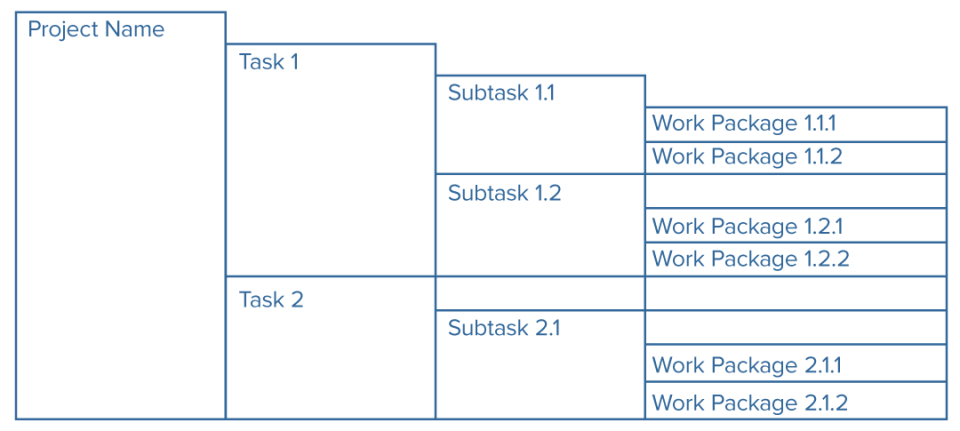
The complete work breakdown structure is the basis of the project schedule, which tells you when each task should start and end in order for the building to be set on time. To arrive at the schedule, construction planners make up one's mind chore durations and establish the precedence relationships betwixt tasks.
Task durations are the lengths of fourth dimension required to complete each task, and are determined by a number of factors. Some of these factors are controllable (for example, the number of personnel or the type and availability of equipment needed to complete a job) and some are uncontrollable (the fact that cement must dry for several hours earlier the next process tin can happen, regardless of the resources bachelor). Experienced builders estimate task durations based on how long information technology took them to do similar tasks in prior projects. Often, planners will use statistical techniques, such every bit program evaluation and review technique (PERT) to estimate the fourth dimension required to consummate a task.
Precedence relationships are the logical gild in which yous will complete tasks. A combination of bones job logic — figuring out what must happen earlier, during, and subsequently performing a specific task — and concrete or practical constraints determine precedence relationships. Builders have an intuitive understanding of job logic: You have to lay the bricks before yous can pigment the walls.
Other constraints that tin can be hard to see in accelerate may affect task execution. For example, it may appear that the cabinetry team and the painting team can piece of work simultaneously, except that the space is too small for all the workers.
Once you determine task durations and precedence relationships, you lot tin can create a precedence network. A precedence network is a visual representation of all projection tasks that you arrange in logical order. Nodes, or hollow circles, represent activities that contain written chore durations, and arrows between nodes represent the social club in which you perform tasks.
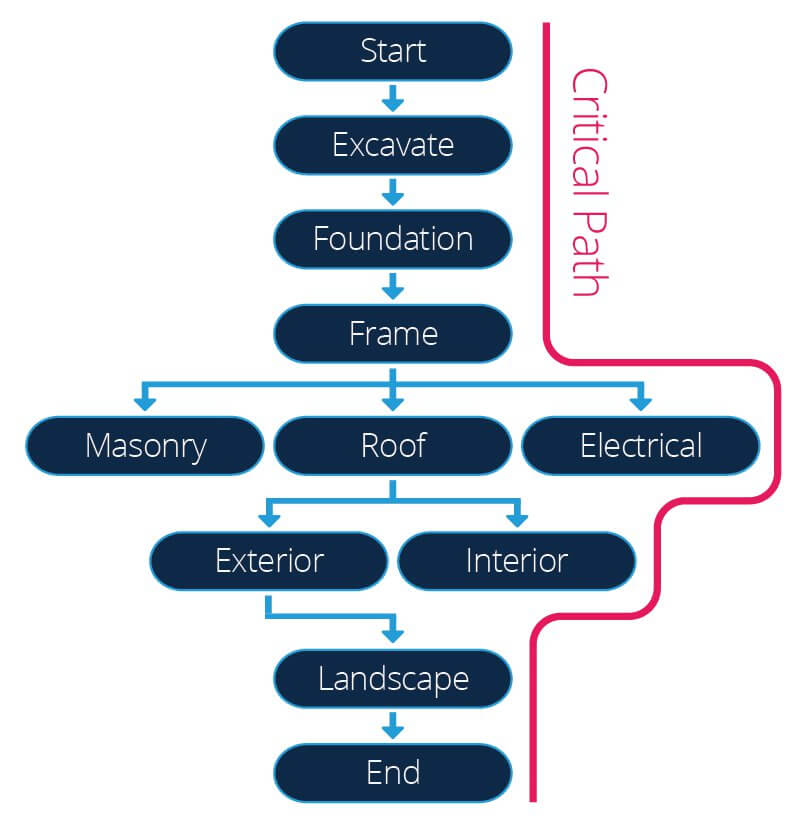
The precedence network drives scheduling with a technique called the critical path method (CPM). The CPM establishes the early on and late start and finish dates for tasks — that is, when you can (or must) start and stop them in guild to complete the project on time. It besides identifies the project'due south critical path, a sequence of activities for which any delay will push dorsum the project'south completion date.
Since all of these activities follow from the work breakdown structure, yous tin clearly see the importance of construction plans to the planning and scheduling of a building project.
Construction Drawings Assistance Planners Make Key Edifice Decisions
Blueprints also shape other important decisions, such as the choice of technology and construction methods for a project. Builders assess the calibration not only of the project as a whole, but as well of specific components of the project, such every bit edifice materials and their position within the structure. This process allows contractors and structure planners to figure out what kind of equipment and construction techniques they'll use.
For instance, a construction planner might ask whether a project requires a cement mixer truck or simply a cycle-based cement mixer. And, in one case the crew mixes the cement, practice they need to pump the mixture to the college levels of the structure, or tin can they transfer information technology by caster or fifty-fifty manually?
Blueprints besides make it like shooting fish in a barrel to check if the structure conforms with building rules and codes and if it's ready for edifice departments to issue permits for new and renovated structures. About jurisdictions have building departments or councils that must result permits for new construction or renovation projects before the construction work can begin.
For example, inspectors will check whether buildings have adequate fire protection and safely positioned windows, include enough parking, and many other details. Project owners seeking a building permit communicate these details past submitting the blueprints for review. Government allow departments will pore over the plans and check for compliance with edifice rules and codes earlier giving construction the permission to intermission basis.
Plan Specifications and the Construction Estimating Process
Before, we touched on specifications and how they're different from construction plans. Builders use a standardized coding system, such as MasterFormat, to simplify specifications and make it easy for all participants to communicate requirements. MasterFormat, developed by the U.Southward. Construction Specifications Institute (CSI) and Construction Specifications of Canada, comprises 50 major divisions of construction data for commercial and institutional projects.
In this coding organization, you identify each work product with a series of numbers that describes the major category and subcategory, and the blazon of work involved. For example, masonry is in division 04, and the dirt unit masonry is in subgroup 21. Brick masonry gets MasterFormat number 04 21 13, which you would use on the construction plan.
Construction plans aid builders estimate costs, specially during the early on stages of a project when contractors are preparing bids. To arrive at a cost estimate, you utilize a technique called quantity takeoff and fix a document called the bill of quantities.
The quantity takeoff calculates the materials you lot need in a construction project. Its name derives from the expression "taking off," and it lists material quantities from the structure drawings and specifications. You list, for example, how much woods you require for an activity, and so you multiply that amount by how many times that activity occurs during structure.
The quantity takeoff is a fairly specialized functioning performed by an estimator who can both read blueprints and quantify all costs for work tasks without overlooking anything or double counting. Pinpointing costs is tricky - even for someone who can read blueprints - because architects vary in how clearly they enumerate all dimensions on construction plans. A toll computer or quantity surveyor typically performs the quantity takeoff.
Utilize this quantity takeoff worksheet to get a sense of the process.

Download Quantity Takeoff Worksheet for Construction
Excel | Word | PDF
The bill of quantities lists the material quantities from the quantity takeoff, and contractors utilise this to determine their expenses on materials and labor for the project. This adding enables them to bid accurately. The bill looks like an extensive table of itemized costs: The scope of each item is described in some detail and accompanied by the number of units of each detail (in terms of area, length, book, or other dimensions as advisable), the price per unit of measurement, and the resulting total cost of that item. The bill of quantities also includes and then-chosen contingency costs for unforeseen expenditures and waste costs and materials prone to breakage or wastage. Since the neb of quantities is an exhaustive document, y'all simply set it one time you take a completed and finalized fix of construction plans.
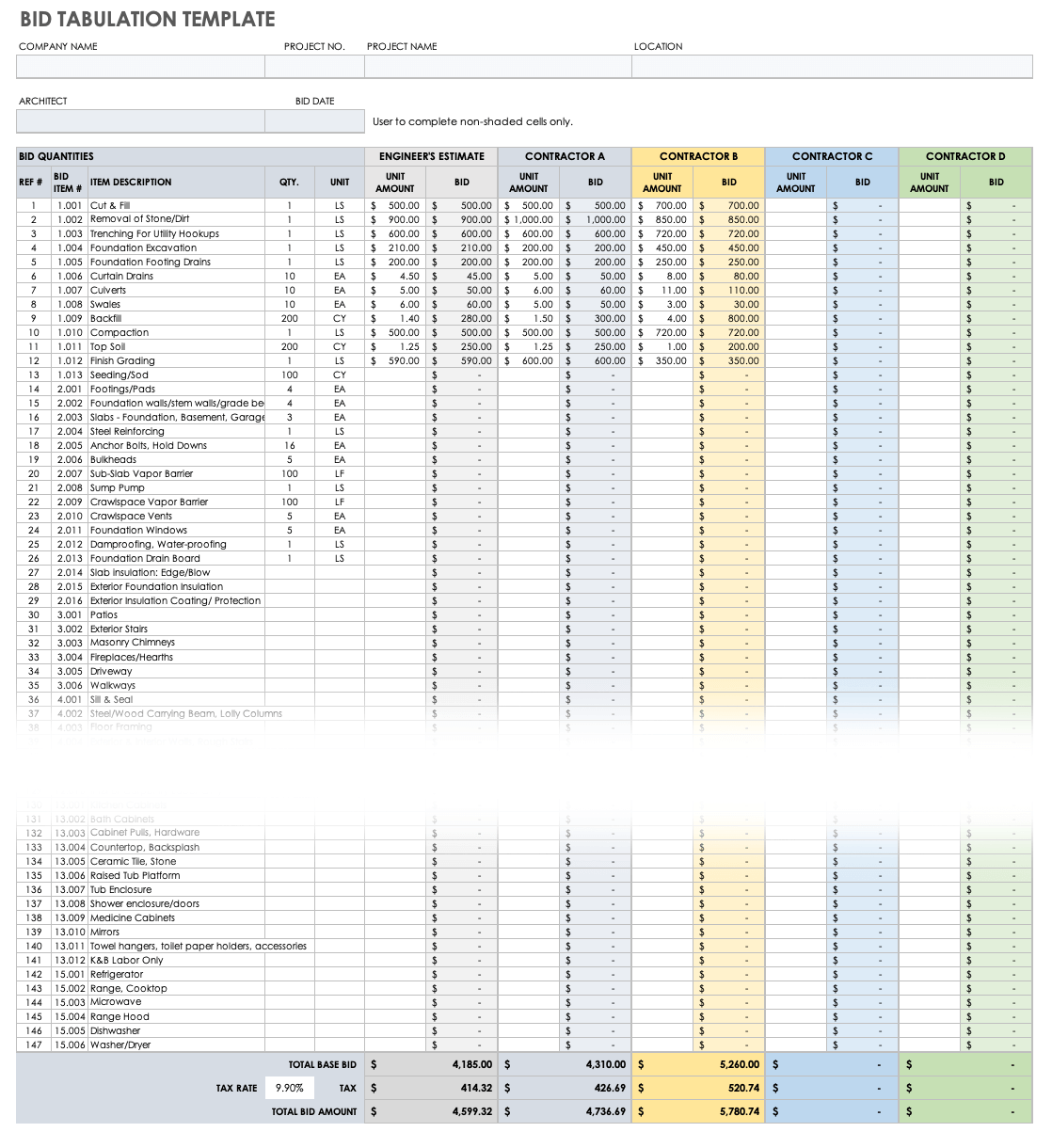
Download Bid Tabulation Template
Excel | Smartsheet
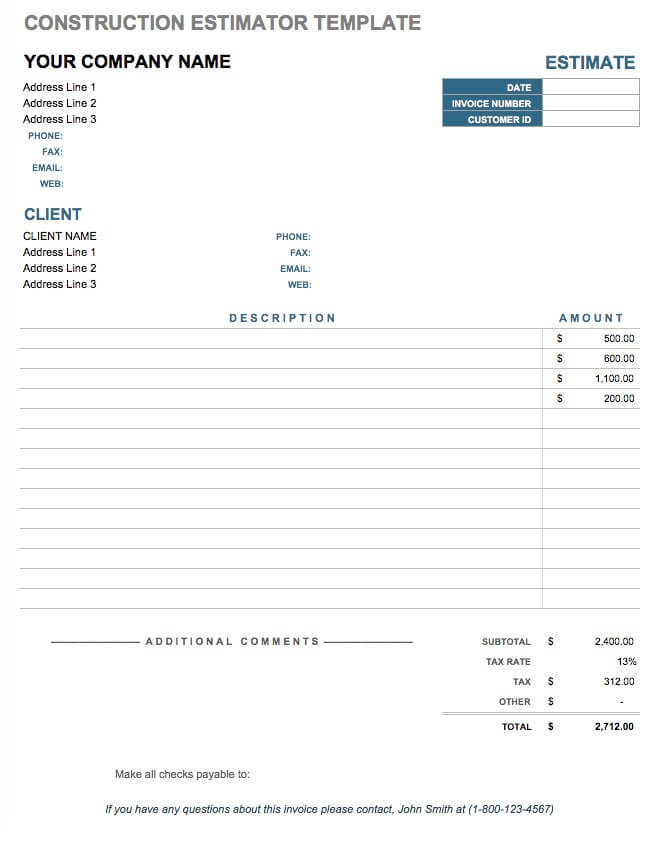
Download Structure Estimator Template
Excel | Smartsheet
Working with Structure Plans
Newspaper construction plans are big (about 24 by 36 inches) and consist of several pages. To first working with these documents, you'll start need to clear a workspace where you tin can fully unfold the plans. Also, call back that newspaper plans tear and fade easily, and they deteriorate if they get wet. They're very expensive to produce and price hundreds of dollars to replace, so make certain you're using them and storing them carefully.
You can easily feel overwhelmed past the sheer size and amount of detail on the plans, and so the showtime step in working with them is to relax. Dissimilar books, plans do non have a single starting identify. Focus your attention on ane corner, and then work your style across. Expert plans show a lot of detail and are highly accurate.
Next, figure out what kind of plan you're looking at: Is the perspective bird'southward eye or side on? Is this a full view or a department? If it'southward a section, which expanse does information technology pertain to?
Next, check the scale. The calibration is the ratio between a construction component's dimensions on the drawing and its actual dimensions. Architects utilize scales with fractions, such as i/8 inch equals 1 human foot, while engineers use whole-integer scales, such as one inch equals 100 feet. Yous use architectural scales in plans for buildings, and engineering scales in plans for other construction projects, such as roads or dams. This guide from the U.South. Fire Administration is a good primer on how to select the correct scale and accurately translate the dimensions.
If the architect possesses written dimensions for the plan, use those instead of measuring the dimensions with a ruler. Co-ordinate to a U.S. Navy pattern reading and sketching course, newspaper volition stretch or shrink over time, which can make dimensions bigger or smaller than you lot intended.
Yous might also run beyond amended plans with written dimensions that don't stand for to those suggested by the scale. Sometimes, in the revision process, you miss details. Cross reference the dimensions you computed using a ruler and blueprint scales with those you've detailed explicitly on the drawing to see whether they agree. Also, try comparing dissimilar plans with elevations to encounter whether the dimensions add upwardly. If yous are measuring dimensions using the ruler and calibration, remember to cheque whether someone reduced the drawings themselves during reproduction.
Since scaled dimensions aren't always accurate, an builder, engineer, or contractor should never rely on construction plan scales to calculate dimensions. Instead, use the dimensions written explicitly on the plans - if these are unavailable, contact the architect to obtain missing dimensions.
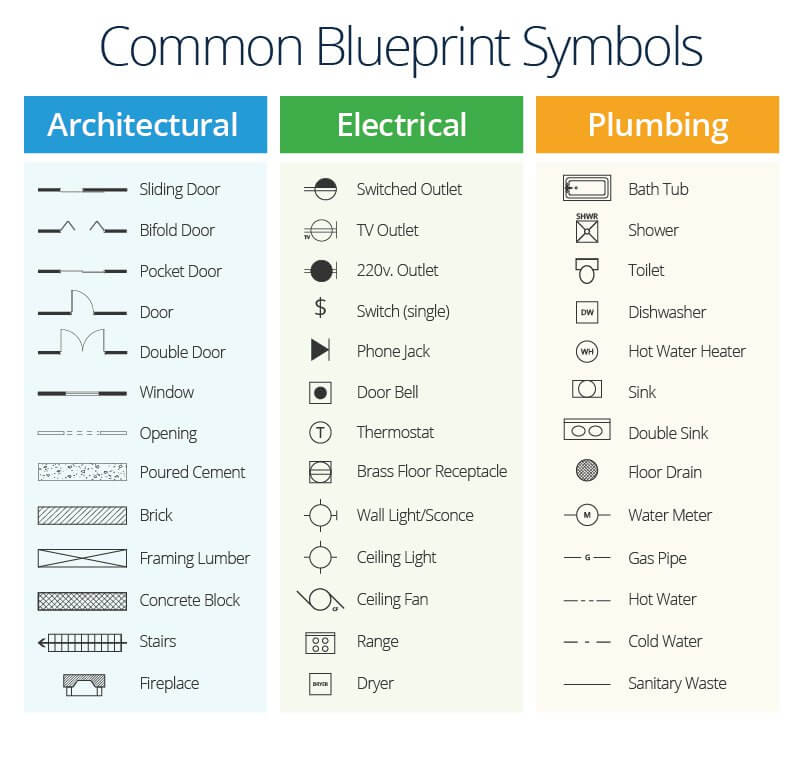
Construction plans feature symbols that represent components of the completed structure. For complex projects, architects may utilize hundreds of abbreviations and symbols. These represent all the structural components, downward to ix different symbols for nine different types of doors. The symbols are more often than not standardized, just architects have breadth to use their ain symbols. Either fashion, the plan will feature a primal explaining what the symbols mean. In add-on, the architect will depict elements, like stonework, using simple graphics. If you want to brush up on blueprint symbols before you get your hands on a set of plans, check out these complimentary resources that HousePlanHelper.com offers.
On your plan, you'll notice several different types of lines. These lines betoken everything from the visible and invisible sides of objects to the dimensions and center axes of objects. Effigy one-3 in this Army Carpentry Field Manual details all the types of lines y'all'll meet in architectural drawings as well as what they mean.
The General Lodge of Drawings in a Set of Construction Plans
A set of plans for a single residential project tin can include dozens of separate drawings (in some cases, there might be more 100). There's no standard practice for how many drawings a ready of plans will include: It depends on the project, the architect's preferred level of detail, and the customs of the architect'southward part. Quickly scan the entire set of plans before you start, and so you know what the builder has included.
The topmost sail is the cover sheet. It includes the date, the proper name and location of the projection, and the architect'south proper noun, accost, and contact data. The cover sail may also feature an architect's rendering of the completed structure.
In many states, applying for a construction permit requires an builder or engineer to stamp the drawings. Stamped plans behave the seal of a registered and licensed engineer or builder. The professional person applies the seal with an ink stamp that shows the person'south name, state, license number, credential, and expiration date for their license.
Subsequently the cover sail comes a plan index, which lists all the drawings contained in the set. It also contains a list of unremarkably used abbreviations, a scale bar that indicates the plan scale, and design notes if needed.
Typically, the architect will place each cartoon with a letter and number. The letter denotes the program serial: A for architectural plans, Due south for structural technology plans, Eastward for electrical plans, K for mechanical plans, and P for plumbing plans. The number refers to a specific plan type. (For example, A2 plans are site plans, A3 plans are floor plans, and A5 plans are roof plans.) If the structure has multiple levels, the designer will add boosted numbers. Each architectural firm uses their own plan-numbering conventions.
The typical order of drawings later the cover sheet and plan index is equally follows:
- Grand for General Sheets: Cover sheet, plan index, and location plans
- A for Site and Architectural Plans: Floor plans, ceiling plans, roof plans, elevations, sections, wall sections, and others, depending on the builder's chosen level of particular
- S for Structural Engineering: Framing plans for foundations, floors, and roofs
- E, M, and P for Electrical, Mechanical, and Plumbing Components (though small residential plans may not characteristic these)
- Finish Schedule and the Door and Window Schedule: Door, window, and other interior types and finishes
- Specifications: Detailed descriptions of the materials (though these may also exist appended to the A-series architectural plans)
The level of detail (LOD) is proportional to the number of plans in the prepare and determined past the builder on a project-past-project footing. The architect is responsible for making sure the structure'due south occupants and users are safe, then they generally choose to include more item rather than less. There's also a growing trend for architects to include more than details to make it easier for contractors during bidding and construction. If the builder repeats a detail or dimension on multiple floors, they may note that it is "typical at all floors" instead of detailing it on each drawing. Information technology is the contractor's responsibility to make sure they include these repeated details in their estimates.
Each drawing volition also feature a title block in the lower-correct corner, which lists the proper noun of the specific drawing, the drawing number, the proper noun of the party who prepared the cartoon, the appointment, the record of approval, and the scale. Architects may create their drawings on gridded sheets to make pinpointing the location of various structure components easier if people are viewing the sheets simultaneously from remote locations.
If you've revised a drawing, you'll as well include a revision block (usually in the top-right corner of the cartoon but sometimes equally office of the championship block). Check the revision block to brand sure you're looking at the latest approved drawing. A numbered bubble indicates a revision on a drawing. In a corner of the drawing, y'all provide a record of revision dates and descriptions with respective numbers, normally in easily recognizable shapes, such equally a triangle or octagon. If you lot brand revisions, a good practise is to insert the new sail in front of the canvas you lot're changing. You can fold the old sheet in on itself and tape it airtight. Mark the sheet number "void."
You'll as well hear references to two other types of drawings: redline drawings and as-built drawings. Redline drawings, and so named because you draw them in red over the original construction plans, indicate where the actual constructed structure differs from the original plan and typically signal merely pocket-size changes. Equally-built drawings incorporate the changes from redline drawings, in upshot making them official and depicting the final construction equally built.
No set of drawings is ever perfect, and there volition be discrepancies between different plans that feature the same structural components. To shift responsibleness for these discrepancies onto the architect, the builder volition typically specify that the contractor follow the highest standard of quantity or quality in case of conflicting data.
Additional Plans for Steel Construction
The construction plans for a steel construction volition typically feature other drawings in improver to the general plans, which depict the main members of the steel structure, item their size and material, and bear witness their position relative to each other.
Fabrication drawings detail the size, shape, and cloth for each fellow member of the structure likewise as the means in which each member connects or attaches to other members. You use the fabrication drawings to procure the required materials for construction.
Erection drawings show the placement of members in the final structure, and commonly detail their weights. Y'all design these mainly to aid fieldwork.
Falsework drawings show whatever supportive structures that yous volition demand to temporarily cock effectually the main structure.
Construction Plans for Different Building Parts
Permit's delve into each plan blazon in detail. For a look at the construction plans for a typical residential project, cheque out what the firm Donald A. Gardner Architects provides in 1 of its firm plan sets.
Foundation plans are a blazon of structural engineering science programme. They can also refer to subfloor plans or, in some cases, basement flooring plans. They show the sizes, shapes, thicknesses, configurations, and elevations of foundation walls and footings, including interior load-bearing walls and exterior post footings. Foundation plans will also show the positioning of reinforcing bars and the connections and attachments via ballast bolts or weld plates betwixt the foundation's structural members. These plans delineate excavated and unexcavated areas of the foundation.
A footing schedule accompanies the foundation plan. It lists and describes all the footings upon which the structure volition rest. Typically, there will be all-encompassing notes that explain how you reinforce structural members and define the concrete break forcefulness requirements. The notes will too describe how y'all exam the strength of the structure.
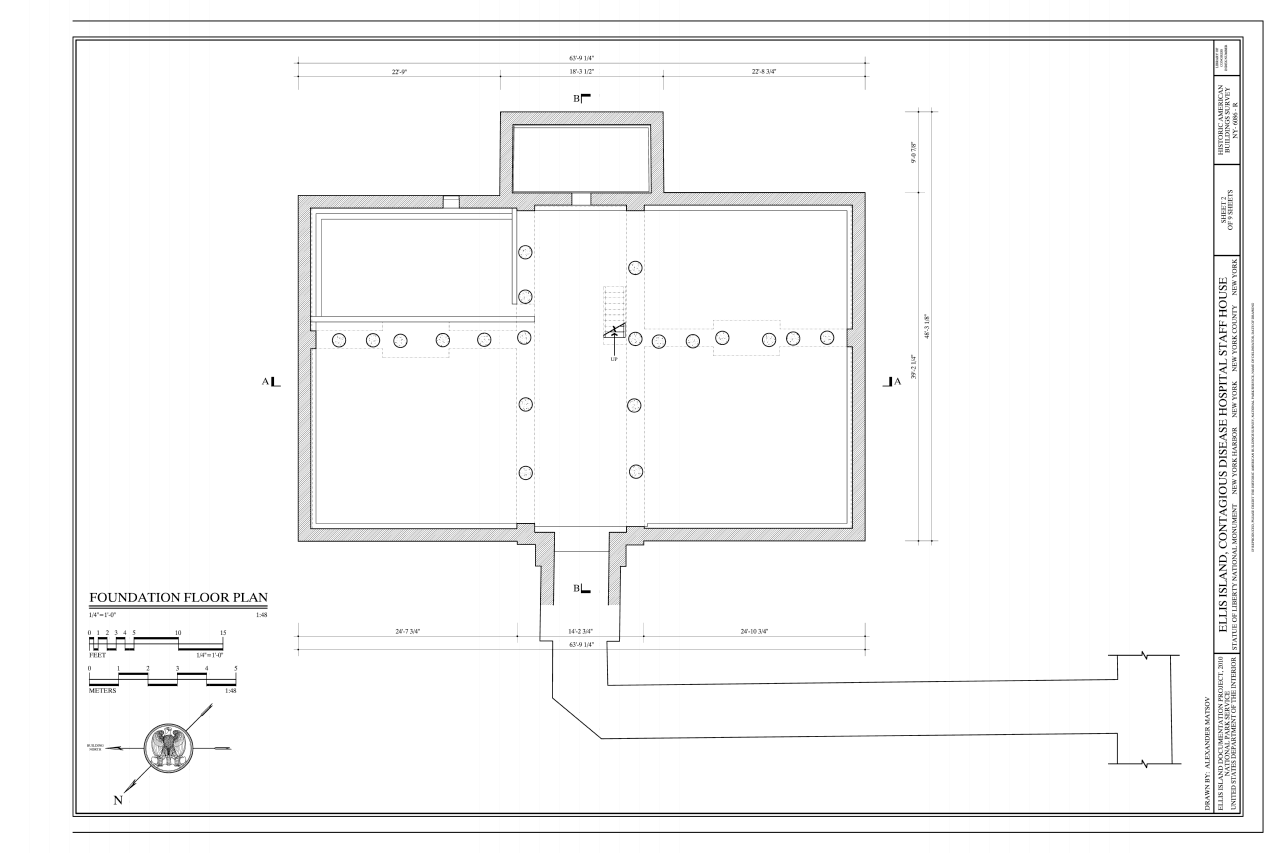
Framing plans are another type of structural engineering plan. They item the structural members that constitute the building's framework: the size and positions of beams that announced in plans, and the joist and rafter space, layout, and size. Framing plans aid builders lay out roof, floor, and ceiling structures.
A framing plan for a roof volition show the various elements of the roof'southward construction, including dormers, hips, valleys, drains, and whatever equipment mounted on the roof. It also shows the roof pitch. Pre-engineered floor and roof systems are also available. If you use these, the manufacturer must provide technology information to the builders, and building inspectors will probably want to review the plan before issuing a permit.
Floor plans are architectural plans that show the layout of each level of the construction. The drafter shows the layout from an overhead perspective that omits the roof and any upper floors. The floor plans illustrate the configuration of internal walls, doors, windows, and wall insets, such every bit fireplaces and chimneys. They also indicate the placement of permanent fixtures, such as bathrooms, major appliances, and internal structures (stairways or elevators).
Each floor will have a flooring plan that includes a description of the intended uses of rooms or other internal spaces. The designer will indicate both door and window sizes and give dimensions, including lengths, widths, and internal square footages. Homeowners tend to exist about interested in the floor plan, as information technology'southward perchance the nearly straightforward and modifiable of all construction documents. The floor plan also makes it piece of cake to picture how foot traffic will flow and how people volition use the space.
One uncommon variation of the flooring plan is the ceiling plan, which is a view of the ceiling as seen from below. Ceiling plans are only used for structures that take significant ceiling fixtures (so typically non residential projects).
Elevations are side views of a building that may show either the exterior or the interior and omit external walls. Exterior elevations show the placement of doors and windows, the external finish of the building, including any masonry or other decorative elements, and a side view of the roofing. They may as well indicate the natural slope of the ground effectually the base of the building. Interior elevations bear witness the height and placement of cabinets, countertops, and detailing, such as tiles on bath walls.
Elevations communicate height, a dimension that bird'southward-eye views tin't display effectively. Elevations also indicate the direction that an meridian faces, equally the direction of sunshine and wind patterns is important when deciding how to place buildings, specially houses.
You should cross-reference elevations with floor plans. Many people assume the architect will include an elevation for every outside wall, but this is non e'er true. Compare the flooring plans to the elevations to make sure you oasis't missed anything.
Cross sections are also a kind of side view, but these correspond a vertical slice through the building to show all internal components. A cross section details both visible components, such every bit stairs, sidings, and roofing, and curtained components, such as framing members, headers, and insulation. A cantankerous section can pass through whatever level of the house, from the roof to the footings. It captures things like cabinets and countertops, and likewise internal framing components (this is important because bird's-center views tin can't draw them effectively). I common type of cross department is a wall cross section that shows both the inside and outside faces of walls as well as internal components, such as studs and insulation.
Where a uncomplicated residential project might simply require a few cross sections, a more complicated commercial structure might need many more than, since there are many variations in the components that go behind walls. You will cross-reference cross sections on plan views and elevations.
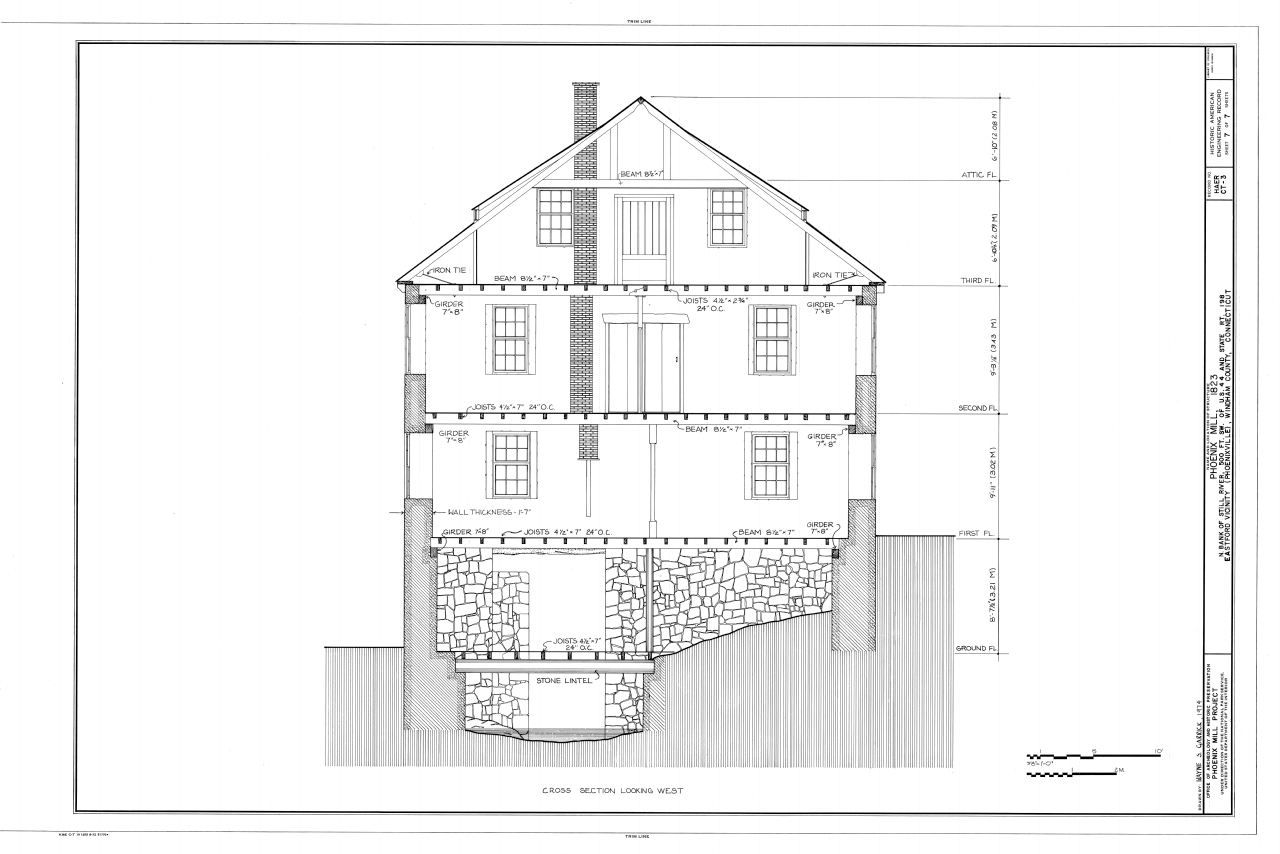
Site plans locate a building in the wider context of the land or parcel. They detail the full general dimensions and location of the site with reference to neighboring lots and their boundaries, and also mark the building'south footprint on the site, and identify site landscaping features,roads, and pavements. Ultimately, the site plan summarizes work you volition complete on site.
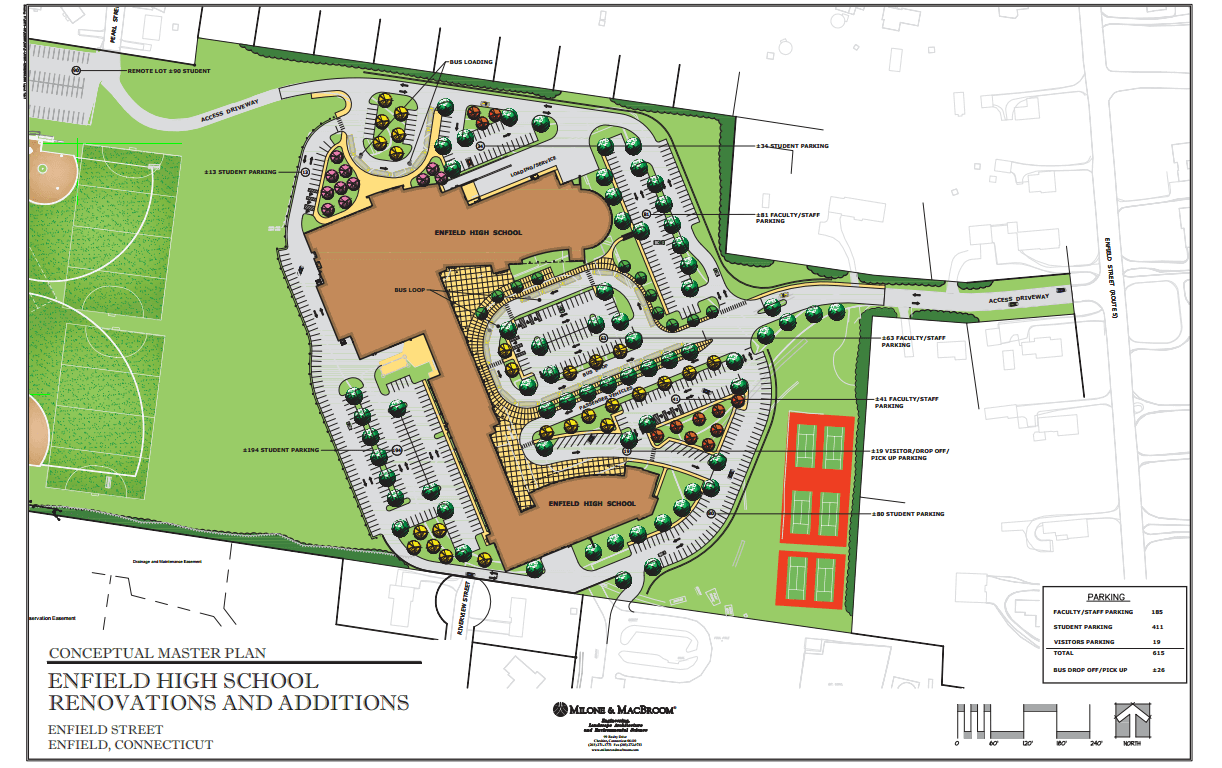
The site plan locates existing infrastructure that you lot need to protect during construction, such every bit sewer lines and utilities connections. It contains information on the class and summit of the construction site. These plans show the location of structures that are not part of the building proper, such as drainage systems and roads. Building inspectors considering whether to award a construction permit volition check whether parking will accommodate the new structure's occupants.
Mechanical plans, like floor plans, are overhead views. They feature the mechanical components of a structure, such as HVAC, gas lines, and plumbing. Putting these details on a separate sail prevents conventional plans from condign likewise crowded and hard to read. Non all construction projects volition have split mechanical plans - you usually but create them for projects with complex mechanical systems.
Mechanical plans volition depict both the visible and concealed components of mechanical systems — both ventilators and ducts for a HVAC system, for example. These plans may also show whatsoever appliances continued to a mechanical arrangement, such as gas ovens. When examining mechanical plans with multiple extensive systems, remember that space restrictions may mean that subcontractors have to piece of work in serial, non simultaneously.
Environmental plans address how the project will manage erosion and sedimentation of waters near the structure site. Given the amount of earth displaced and moved during structure, they're designed to ensure that all that soil doesn't end up polluting and blocking nearby waterways. Ecology plans as well include procedures for minimizing plant removal and dealing with chemical spills.
The environmental plan typically lists a series of all-time management practices (BMPs) designed to minimize the harmful impact on the environment. In many jurisdictions, an environmental plan is a requirement to proceed with structure.
Schedules feature all the details an architect doesn't desire to squeeze into a floor programme. A schedule is a simple matrix of building component information, where each entry corresponds to a number that besides appears on the floor plan. Schedule information is highly detailed: A door schedule, for example, will feature data on doors, door frames, and locks. A finish schedule is a comprehensive table of finishes (paint, floor, etc.) in each room. Windows and calorie-free fixtures will also announced on schedules.
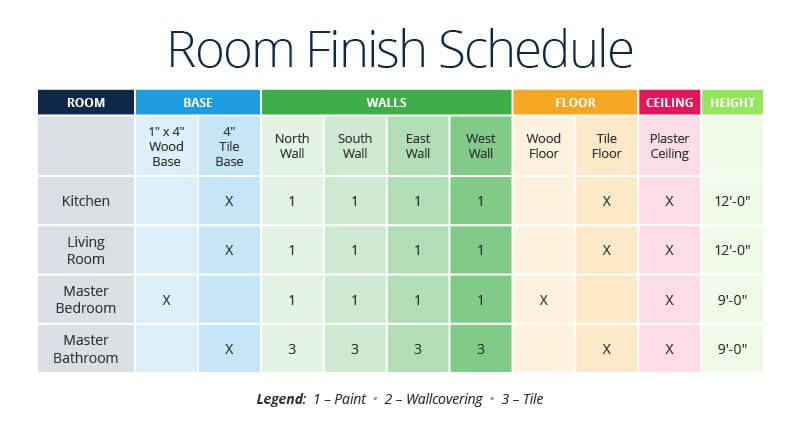
Schedules will also include items labeled OFCI (owner-furnished, contractor-installed), GFCI (government-furnished, contractor-installed), NIC (not in contract), and past others (those items provided outside the scope of a particular trade or contractor). In general, the schedule volition also show delivery dates for items that you have ordered.
To learn more nigh blueprints and how to read them, check out this class by Structure Experts Inc. The book Blueprint Reading: Construction Drawings for the Building Trades also covers the topic, and Francis D.G. Ching's Building Structure Illustrated is a helpful reference. Print Reading for Construction, by Walter Brown and Daniel Dorfmueller, is another resource.
How to Lay out a Building Footprint from Blueprints
Interested in learning exactly where a structure will lie on a lot? You'll take to lay out the building'south "footprint," which is the expanse of state information technology occupies at footing level. Being able to do this, or at least understand it very conspicuously, is a core piece of structure knowledge.
To start, look at the site plan to observe reference points that will allow you to locate the structure. If the site programme doesn't make reference to existing landmarks or features of the landscape, chances are it uses a coordinate system comprising northings and eastings to locate the edifice. Y'all'll too need to utilize an musical instrument called a total station theodolite (TST) to determine the edifice's coordinates. Remember, the smaller the lot and the closer it is to other structures, the greater the need for precision when locating the edifice's coordinates. Start past locating the corners of 1 side of the building, and measure distances to landmarks to make sure you lot've positioned the corners correctly. Work your way around until you lot've located all the corners.
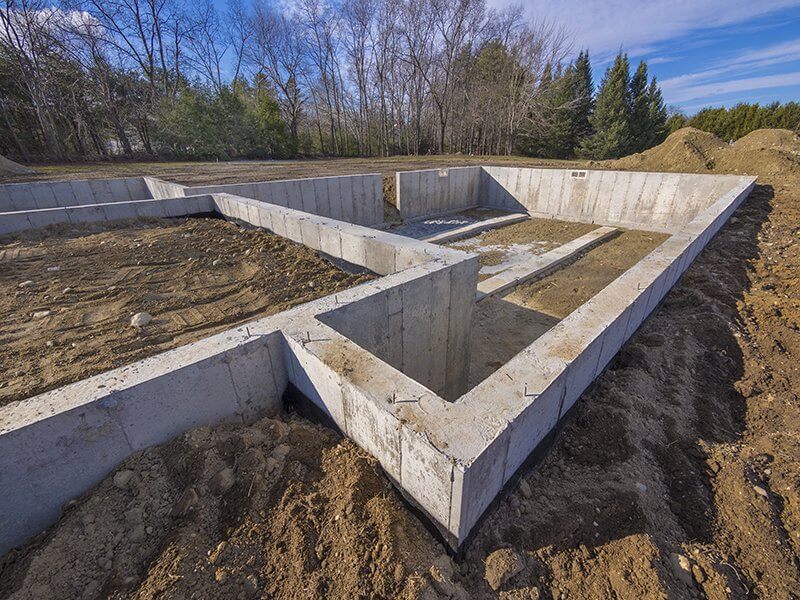
Your next footstep is filling in the lines between corners. There are a number of ways to exercise this, depending on the type of structure that you lot intend to build: Y'all might measure out and locate cavalcade lines, foundation lines, or outside wall lines. An architect or builder can tell you which is nearly advisable, and you'll need to learn how the different line types appear on the site programme. Use a triangle-type rule to scale distances on plans, equally they're less likely to consequence in measuring errors. If you need to add together distances, employ a builder's estimator, which will expedite mathematical operations based on dimensions. CAD plans too help determine distances, especially inside the outside building line (OBL).
Building piece of work typically needs to start on level surfaces, so yous'll also need to establish the elevation, if whatsoever, from which work will commence. The elevation is computed with reference to nearby structures or to sea level (check out the Australian Height Datum). The site program will indicate a measurement chosen the "height above the existing class," or will use an existing vertical marker to bear witness the elevation.
Construction Safety Plans Can Save Lives
So far, we've talked most construction plans specifically as documents that provide technical data about a structure and how to build information technology. These plans include blueprints, specifications, and schedules. But construction plans also refers to the results of the broader planning process that encompasses environmental, condom, and quality plans.
Safety plans are important because construction is hazardous, and the best way to prevent an accident is to conceptualize what could go wrong. In 2015, according to the Occupational Rubber and Wellness Assistants (OSHA), one in five private-industry worker fatalities — a total of 937 deaths — occurred in the construction industry. About ane in 10 U.S. construction workers will sustain injuries in any given year. Falls cause the most injuries.
Safety planning isn't as rigorous in small-scale residential projects, but information technology is a regulatory requirement for large projects. OSHA standard 29 CFR 1926, "Safety and Wellness Regulations for Construction," defines construction project safety standards, and OSHA has 10 construction prophylactic programme requirements for the construction manufacture.
Safe planning revolves around risk reduction and hazard emptying to avert on-site accidents. It's most effective when integrated proactively with project planning and so that it evolves with site and environmental conditions.
Safety planning is an integral function of construction pattern and scheduling. Builders who identify potential hazards for construction crews — a exercise called job hazard analysis — tin can proactively mitigate them by implementing safe measures and emergency response equipment. This extends from observing occupancy limits for bars spaces to making burn down safety equipment available close to where it might be needed. These risk-command steps, forth with plans for what to do if an accident occurs, are the project'due south safe management strategies.
If yous need to compile or evaluate a construction plan, information technology helps to know the traditional elements. Review OSHA'due south condom checklist for construction. A structure safety plan must include certain sections and respond fundamental questions, such equally who is in charge of safe on site, what arrangements exist for medical handling, what safety training you lot will conduct, and the lockout/tagout procedures.
Use the checklist beneath as a starting point for your site condom programme. Nonetheless, remember that your final safety plan needs to be specific to the hazards present in your unique circumstances. Follow all applicable regulations, such as OSHA requirements.
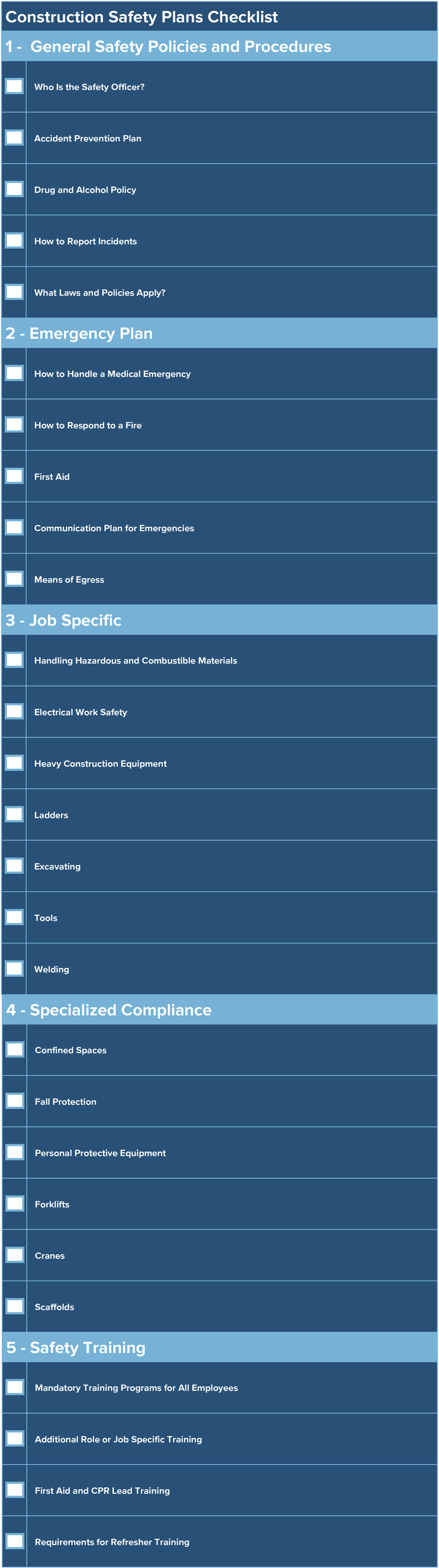
Download Construction Safety Plans Checklist
Quality Plans Help Builders Thrill Clients and Users
A construction quality programme is a document that explains how a contractor will meet the quality requirements for a specific project. Information technology's not the same as a company'south general quality policies, since it addresses quality management for an individual project.
Whether formally required in a contract or informally requested, the quality plan is an important part of the customer-contractor working relationship. For the client, it improves conviction in the contractor's ability to get the task done and builds in a mechanism for accountability. For the contractor, it ensures all parties are on the same page and that the project outcome will enhance their reputation.
The quality programme for a project identifies those responsible for quality direction and establishes protocols for quality-related communications. It highlights the regulations and industry standards that apply to a project, and explains procedures for assessing quality. Lastly, it explains how subcontractors comply with the programme and the quality requirements for materials procurement.
Ed Caldeira of First Time Quality explains what a expert quality management plan will tell a customer:
- "Who is in charge of quality management on the project, and what are their qualifications?
- How and when will you communicate quality-related problems to the contractor'due south personnel and the client?
- What sort of quality oversight system will you put in place?
- How volition you ensure quality from subcontractors and suppliers?
- What constitutes satisfactory quality for a project? What quality standards will y'all set?
- How volition you test quality?
- Should they ascend, how will yous fix quality issues?
- How volition you appraise the projection's deliverables quality?"
When developing a quality control plan for construction, consider covering the following topics:
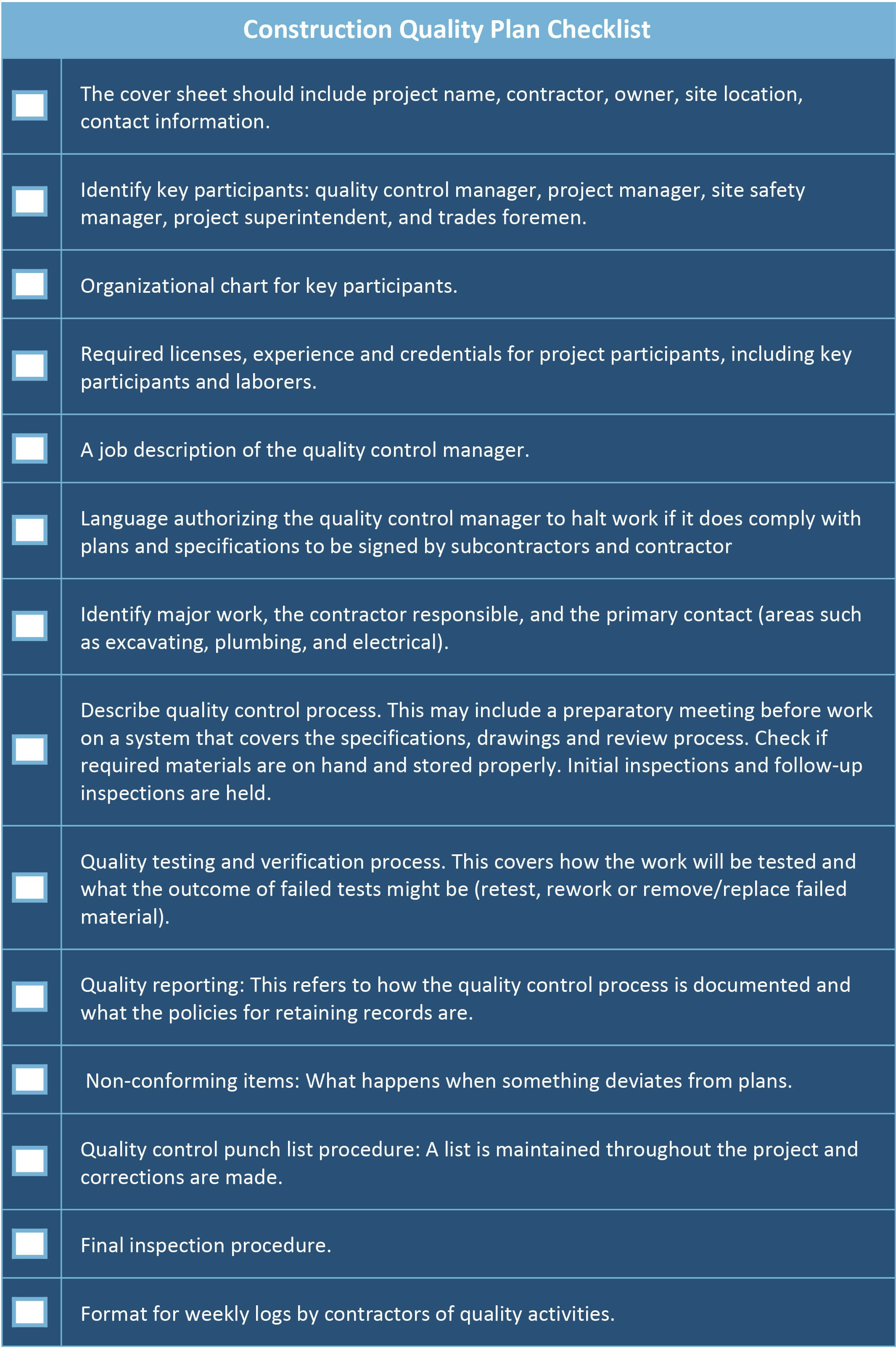
Download Structure Quality Plans Checklist
Engineering science Eases Construction Planning
Earlier we talked about the difficulty of working with blueprints. Structure has lagged backside other major industries in digital adoption, and planning technology solves many of the problems and constraints of conventional paper construction plans.
Construction planning technology covers a number of software solutions, from scheduling apps to SaaS suites. The design modules reduce the time and coin costs of manually updating construction plans and reworking design elements.
The most helpful features include the following abilities:
- View, edit, and share drawings
- Access plans and documents in the field from mobile devices
- Zoom in with high-resolution plans to capture detail
- Ensure sail version control
- Shop in the cloud
- Recall plans quickly with fast-loading optimization
- Annotate with markups and as-built notes
- Take photos and share and annal them
- Automate quantity takeoff
These capabilities unlock some stiff advantages for builders and projection managers. With these tools, collaboration flows more easily, everyone always has the electric current prepare of plans, accuracy rises, and all participants (whether they are in the office or the field) share the same information. Scheduling engines give contractors a competitive advantage past increasing productivity. Quality as well rises since project teams can update and share blueprints, punch lists, specifications, and RFIs instantaneously.
These capabilities increase efficiency. Ane structure software company surveyed its customers, who said that on boilerplate they saved $15,000 in labor per year per employee past using a construction solution.
That financial benefit accrues from greater efficiency. Simply not using paper plans as well saves on printing costs. Aside from architect fees, plans typically cost $2 to $4 a page to impress. The documents sets for large commercial projects will have hundreds of pages, and many project managers, supervisors, and foremen need their own set. You lot'll also have to reprint sheets when in that location are changes, and since changes are common, the costs quickly add together upward. Of course, using digital plans means team members must have tablets or laptops and a subscription to an application that generally has a fee.
These tools would not exist without other technological innovations in the construction plan world, such as CAD and building information modeling (BIM). CAD was the forerunner to BIM: It began as the groundbreaking use of software to design physical components, especially in manufacturing, though civil applied science projects used it too. Designers then embraced it for drawing plans.
BIM is the side by side stage in construction design. It goes across two-dimensional CAD to 3D building information models that offer comprehensive data for entire structure projects. BIM provides highly complex digital representations of building design, and it'due south stretching beyond 3D visualization to so-called 4D and 5D integration of fourth dimension and cost information.
CAD fabricated information technology easy to view, edit, and share construction drawings, with no perceptible loss of quality. CAD plans besides brand dimensions easier to measure. These drawings mimic some of the strengths of traditional paper plans but are easier to share and mark up.
Glossary of Key Terms in Construction Plans
Below, you'll discover a useful list of terms concerning structure plans.
- Building Envelope: The complete set of physical structures that separate a building's interior from its outside, such as walls, roofs, and floors.
- Ceremonious Drawing: A type of site programme designed for use past civil engineers that shows topographical features, landscaping, and utility connections.
- Eastings: A fix of eastward-extending coordinates on a geographic plane. Together with northings, they establish a organization of Cartesian coordinates that y'all use to plot edifice locations with reference to already existing landmarks. Meet likewise northings.
- Footing: A component of a edifice'due south foundation that transfers the weight you identify on walls to the basis. Compared to other types of foundations, footings are typically quite shallow, though at that place are restrictions on minimum ground depth.
- GFCI (Government-Furnished, Contractor-Installed): This acronym, used on construction plans and specifications, indicates materials or components that the project possessor will procure — in this case, the project owner is the government, and they provide the GFCI to the contractor for installation. The GFCI mark on construction plans tells cost estimators which work items they do not demand to procure. It's too a reminder for the contractor to coordinate a commitment schedule with the government.
- Level of Item and Level of Development: We often refer to both of these terms as LOD. Level of detail describes the increasing amount of item in graphical representation as construction plans become more than refined. A conceptual drawing is much less detailed than a detailed cartoon. Level of development describes how much development and engineering take gone into the feature.
- NIC (Not in Contract): This acronym, used on construction plans and specifications, indicates work items that are not the primary contractor'south responsibility to deliver. The project owner either delivers these piece of work items or contracts with another political party to have them deliver the items. The NIC marking on construction plans tells toll estimators which work items they should not bid for.
- Northings: A gear up of northward-extending coordinates on a geographic aeroplane. Together with eastings, they constitute a organization of Cartesian coordinates that y'all use to plot building locations with reference to already existing landmarks. Encounter likewise eastings.
- OFCI (Possessor-Furnished, Contractor-Installed): This acronym, which you apply on construction plans and specifications, indicates materials or components that the project owner will procure and provide to the contractor for installation. The OFCI mark on construction plans tells cost estimators which work items they practise non demand to procure. Information technology's also a reminder for the contractor to coordinate a delivery schedule with the owner.
- Exterior Building Line: A commonly used reference betoken in construction drawings that helps planners determine distances to other structural components.
- Quantity Takeoff: A technique for estimating the types and quantities of materials and labor required to consummate a construction project. The quantity takeoff is part of the project cost estimating process. It gets its name from the way toll estimators would originally perform the function, when they would "take off" quantities of all materials from blueprints and specifications to prepare an itemized list.
Ameliorate Construction Plans with Smartsheet for Construction
From pre-construction to project closeout, keep all stakeholders in the loop with real-time collaboration and automated updates so yous can brand better, more than informed decisions, all while landing your projects on fourth dimension and within budget.
The Smartsheet platform makes it piece of cake to plan, capture, manage, and written report on piece of work from anywhere, helping your squad be more effective and go more done. Report on key metrics and get real-time visibility into work as it happens with whorl-up reports, dashboards, and automated workflows built to go on your team connected and informed.
When teams have clarity into the work getting done, there's no telling how much more than they tin reach in the same corporeality of time. Endeavour Smartsheet for free, today.
Source: https://www.smartsheet.com/how-to-read-construction-plans
Belum ada Komentar untuk "Nature Walkway Masured Design Plans Wood Drawing"
Posting Komentar